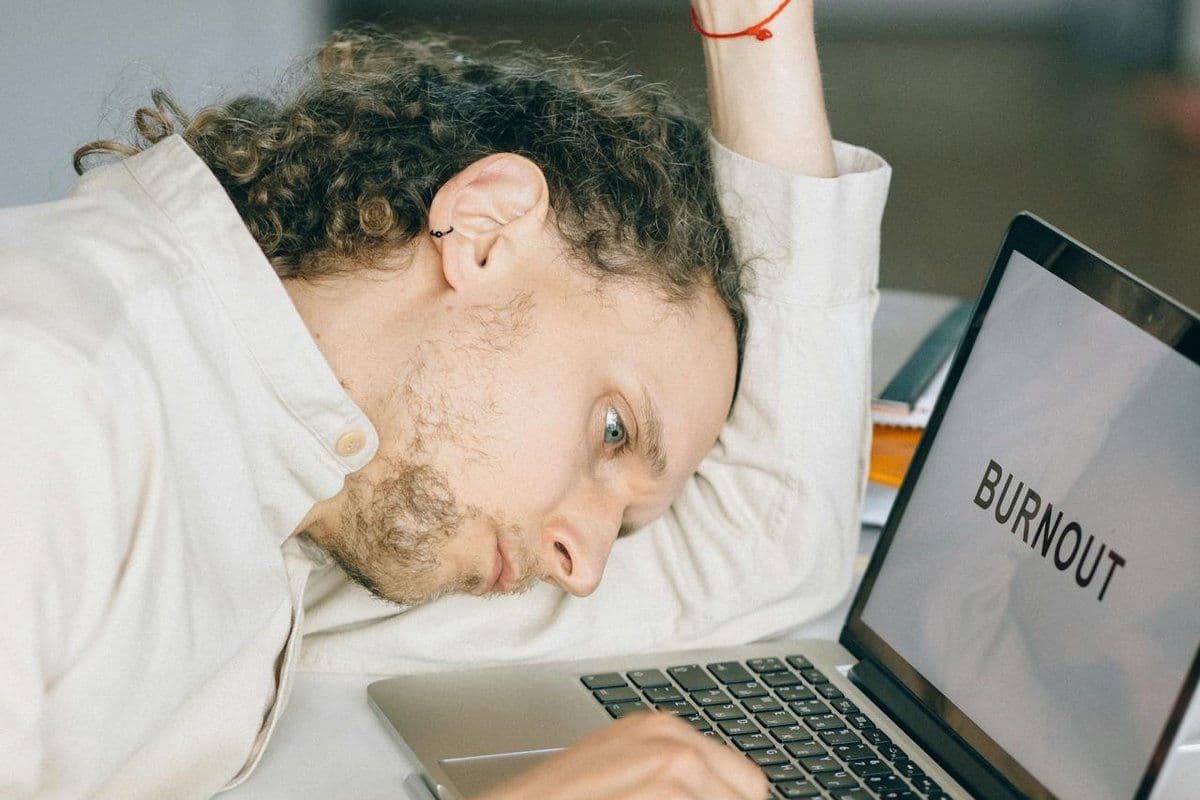
Burnout is talked about everywhere these days, so much so that the word has come to mean almost anything: the tiredness of a busy week, the Monday-morning slump, a passing fed-up feeling. Yet professional burnout is a precise phenomenon, studied for nearly fifty years, and confusing it with simple fatigue often prevents us from spotting it in time.
Understanding what burnout really is, and above all what it is not, is the first step to protecting yourself from it. Here is what the science says, far from the received ideas.
1. Burnout isn't about "too many hours"
The term was first used in 1974 by the psychiatrist Herbert Freudenberger, who observed exhaustion in highly motivated volunteer caregivers. His observation already broke a received idea: it isn't the accumulated hours that wear you down, but the lasting imbalance between what you give and what you receive in return.
Later research confirmed it. Two people can work exactly the same number of hours: one thrives, the other collapses. The difference does not lie in the amount of work, but in the balance between demands (workload, pressure, deadlines, complexity) and resources (autonomy, support, recognition, meaning). When demands durably exceed resources, the body ends up drawing on its reserves until exhaustion.
That's why you can "hold on" for a very long time in a heavy but well-supported role, and burn out quickly in a lighter one that lacks recognition or meaning.
2. The three faces of burnout
In the 1980s, the researcher Christina Maslach showed that burnout can be recognised by three signs, which generally set in in this order:
- ●Emotional exhaustion: the first and most visible. The feeling of being drained, of having nothing left to give, of a tank that no longer refills, even after a weekend or a holiday.
- ●Cynicism (or depersonalisation): a gradual distancing. You become detached, irritable, indifferent to your work and sometimes to others. It's'a protective mechanism: unable to lighten the load, you reduce your emotional investment.
- ●The loss of a sense of accomplishment: the impression of no longer being effective, of succeeding at nothing, of doubting your competence, even though the work produced often remains of good quality.
Distinguishing these three dimensions is useful: you can be exhausted without being cynical, or doubt yourself without yet being drained. The more these signs accumulate, the higher the risk.
3. Why it's'often the most committed who burn out
Here is one of burnout's most counter-intuitive paradoxes: we don't burn out from what leaves us indifferent. Professional exhaustion first affects those who invest themselves, who care about the quality of their work, who struggle to say no and who set the bar high.
This overinvestment isn't a flaw: it's precisely the commitment that makes a professional valuable. But without clear limits or sufficient resources, that energy turns against the person deploying it. It's'also why burnout often surprises those around the person: it strikes people reputed to be solid, reliable, "the ones you can count on."
Understanding this changes how you look at yourself: feeling on the edge of exhaustion isn't a sign of weakness or incompetence, but often the consequence of sincere commitment in an unbalanced environment.
4. Burnout, stress, depression: don't confuse them
These three notions overlap, but distinguishing them helps you respond correctly.
| Notion | What characterises it | My reference point |
|---|---|---|
| Stress | A normal, one-off reaction to a demand from the environment; disappears once the pressure eases. | I recover afterwards, once the situation has passed. |
| Burnout | Exhaustion specifically linked to work, settled in over time; often reversible when the context changes. | I no longer recover, even at rest, and it's centred on work. |
| Depression | A disorder affecting every area of life, with lasting sadness and generalised loss of pleasure. | Everything is affected, everywhere, all the time, not just work. |
Burnout is above all contextual: it's linked to work and tends to improve when the environment changes. Depression, on the other hand, spills over into every sphere of life. But an untreated burnout can progress into depression: that's the whole reason not to wait.
5. A work-related phenomenon, not a personal weakness
In 2019, the World Health Organization included burnout in its international classification of diseases (ICD-11). One clarification went almost unnoticed and yet changes everything: the WHO does not describe it as a disease, but as an "occupational phenomenon" resulting from poorly managed chronic workplace stress.
This nuance has a major consequence: burnout isn't a flaw in the person, but the symptom of an imbalance in the way work is organised. Prevention therefore doesn't rest solely on the individual ("learn to manage your stress better"), but also on the environment: workload, autonomy, support, recognition and meaning.
At the individual level, a health check-up is a valuable moment to take stock. It helps put objective figures on signals we tend to play down, persistent fatigue, sleep problems, tension, biological markers of chronic stress, and to identify the priority adjustments before the situation worsens.
💡 Key tips
- Burnout isn't measured in hours worked, but in the lasting imbalance between what I give (effort, commitment) and what I receive (recognition, support, meaning).
- Loss of pleasure and emotional distancing (cynicism) often appear before physical exhaustion: they are the earliest signals, and the easiest to ignore.
- We don't burn out from what leaves us indifferent: it's'often the most committed and conscientious who are most exposed. Feeling on the edge isn't a weakness.
- Burnout isn't depression: burnout is first centred on work and often reversible when the context changes. But a neglected burnout can tip into depression, hence the importance of not waiting.
- The WHO classifies burnout as an occupational phenomenon, not an individual illness: the organisation of work must be questioned too. A health check-up helps put objective figures on signals we tend to minimise.