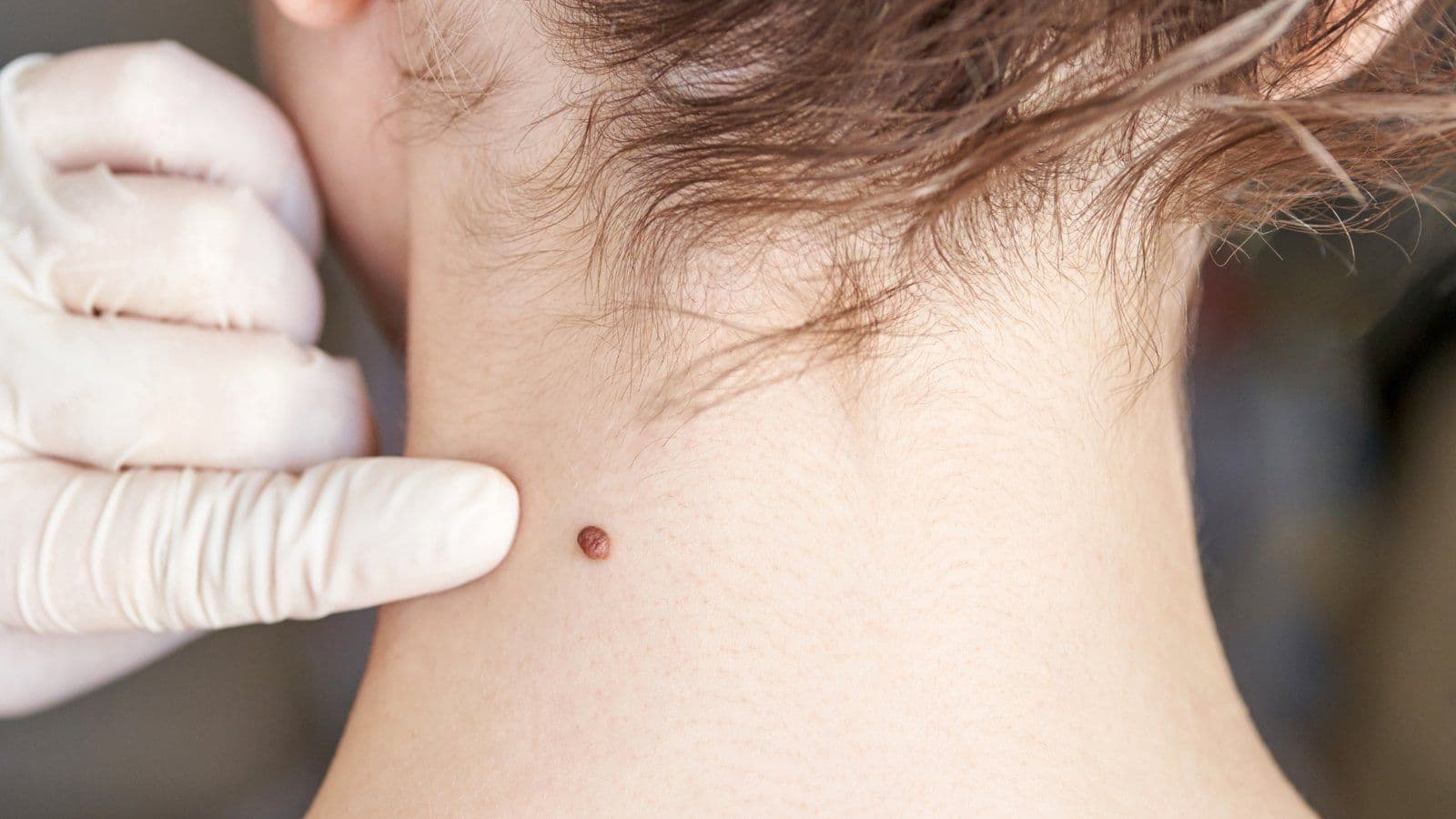
Almost all of us have moles: between 10 and 40 on average in adults. Most are perfectly benign and will stay that way for life. But their number isn't just an aesthetic matter: it's'one of the most solid indicators of melanoma risk. Counting your moles from head to toe, however, is tedious. The good news: there's'a reliable shortcut, and it's'on your arm.
1. Why the number of moles matters
A mole, or nevus, is a small cluster of melanocytes, the cells that make the skin's pigment. Its presence is normal. But the more you have, the higher the statistical risk that one of them evolves: it's'estimated that 20 to 40% of melanomas develop from a pre-existing mole. Beyond 100 moles on the body, melanoma risk is multiplied by 5 to 6 in fair-skinned people. The total number of nevi is thus one of the best-established risk factors, on par with phototype or sunburn.
2. The study that turned the arm into a mirror of the whole body
In 2015, researchers at King's College London counted moles on 17 body areas in nearly 3,700 female twins, then compared the results. Their conclusion: the number of nevi on the right arm, particularly its upper part, is the best indicator of the total number over the whole body. Why the arm? Because it's both highly sun-exposed and easy to observe. Women who counted more than 11 moles on the arm had roughly 9 times the risk of having more than 100 over the whole body. An Australian study had already shown that exceeding 10 moles on the right arm multiplied melanoma risk by 11.
3. The forearm test, in practice
The exercise is simple and is part of your check-up questions. Examine one forearm, from shoulder to wrist, and count the moles about 3 mm in diameter or more. Here's'how to place your result:
| Nevi on one forearm | What it suggests |
|---|---|
| Fewer than 7 | Total number on the body probably moderate. Routine monitoring, like everyone. |
| Between 7 and 11 | Intermediate-to-high total number. Regular self-exam advised, dermatological opinion if other risk factors. |
| More than 11 | Nearly 9 times the risk of having over 100 on the body, a threshold associated with increased melanoma risk. A baseline dermatological exam is recommended. |
Bear in mind: this test isn't a diagnosis. It's'a marker that helps you know whether your skin deserves particular attention, and whether to raise it with a professional.
4. Beyond the number: watching what changes
The count estimates risk; monitoring spots the warning signals. For each mole, keep the ABCDE rule in mind:
- ●A, Asymmetry, B, Irregular borders, C, Uneven colour, D, Diameter often over 6 mm, E, Recent change.
- ●The "ugly duckling" sign: a mole that doesn't look like the others deserves an opinion.
- ●The newcomer after 40: at this age, skin rarely creates new moles; a truly new nevus should be shown to a doctor.
- ●Any unusual symptom: a mole that itches, bleeds, changes in relief or won't heal warrants a consultation.
5. What to do with your result
Whatever your count, the approach stays gentle and gradual:
- ●Few moles: a self-exam once or twice a year is enough, using a shower as a chance to also check your back and hidden areas.
- ●High number or risk factors: request a baseline dermatological exam. The doctor can map your nevi, sometimes by photography, to track their change over time.
- ●In case of doubt: never stay alone with a worry. Better a consultation "for nothing" than a melanoma spotted too late, caught early, it heals in more than 9 cases out of 10.
Knowing your mole capital turns invisible data into a concrete prevention tool: you then know where to look, and when to consult.
💡 Key tips
- A validated 30-second test: count the moles on one forearm (shoulder to wrist). Beyond 11, you have about 9 times the chance of having more than 100 over your whole body, one of the most reliable markers of melanoma risk.
- The arm wasn't chosen at random: it's the body area whose count best predicts the total, because it's'highly sun-exposed and easy to observe. No need to count yourself head to toe.
- The number isn't a fate, but a compass. Having many moles isn't a disease: it simply means you should watch a little more closely and consult at the slightest change.
- Beware the newcomer: after 35-40, the appearance of a truly new mole warrants medical advice. At that age, the skin rarely creates ordinary new nevi.
- 20 to 40% of melanomas arise from a pre-existing mole. Knowing your "nevus capital" and having it assessed during a health check-up helps direct monitoring where it's most useful.
Sources and references
- ●Ribero S'et al., Prediction of high naevus count in a healthy UK population to estimate melanoma risk (British Journal of Dermatology, 2015)
- ●Holman CD, Armstrong BK, Pigmentary traits, benign nevi and family history as risk factors for cutaneous melanoma (Journal of the National Cancer Institute, 1984)
- ●French National Cancer Institute (INCa), Early detection of skin cancers (2024)
- ●French Society of Dermatology, Nevi and mole monitoring